Taskbar Hero Build Guide: Classes, Gear and Upgrade Priorities
A strong Taskbar Hero build is not only a class name. It connects front-line stability, main damage, support value, gear effects, runes, and cube upgrades toward the same job. This build guide explains how to choose a direction without wasting early materials.
Start with a stable damage build, not a fragile damage ceiling
The safest first Taskbar Hero build is a setup that clears your current Act consistently while still dealing enough damage to keep progress moving. If the front line collapses, add survivability. If enemies live too long, add damage. If material returns feel slow, tune the build for farming speed. Do not evaluate classes, skills, gear, runes, and cubes in isolation. Ask what problem the setup is solving, then spend materials only where the answer is visible during a short idle test.
- Keep enough survival that long idle sessions do not fail repeatedly.
- Prioritize gear effects that match the current role over rarity alone.
- Spend runes and cubes on pieces that improve Act progress, stable farming, or a clear bottleneck.
Search terms and this page boundary
Close search terms need clear ownership. This page covers build planning and upgrade decisions; detailed class builds, rune use, and market intent stay on their dedicated guides.
| Search term | Fit for this page | Action |
|---|---|---|
| taskbar hero build / builds | High. This is the core class and upgrade intent. | Use in the answer, tables, FAQ, and internal anchors. |
| taskbar hero guide | Medium. Build planning is one part of the broader guide. | Link to the beginner guide and Wiki home. |
| taskbar hero runes | Related but not owned here. | Link to the rune and cube guide. |
| taskbar hero market | Adjacent equipment-market intent. | Link to the item and market guide. |
Similarweb confirmed taskbar hero build, taskbar hero builds, task bar hero build, and tbh build as related informational terms. Class-specific details stay on their dedicated pages so this page owns broad build planning.
Think in roles: front line, main damage, and support
Exact class numbers can change with updates, so a role-based approach is more durable than a fixed tier list. Idle RPG progress often breaks for practical reasons: the front line dies, the main damage slot cannot finish enemies, or the support slot does not improve the loop enough. Treat every new class or item as a tool for one of those roles before changing the whole build.
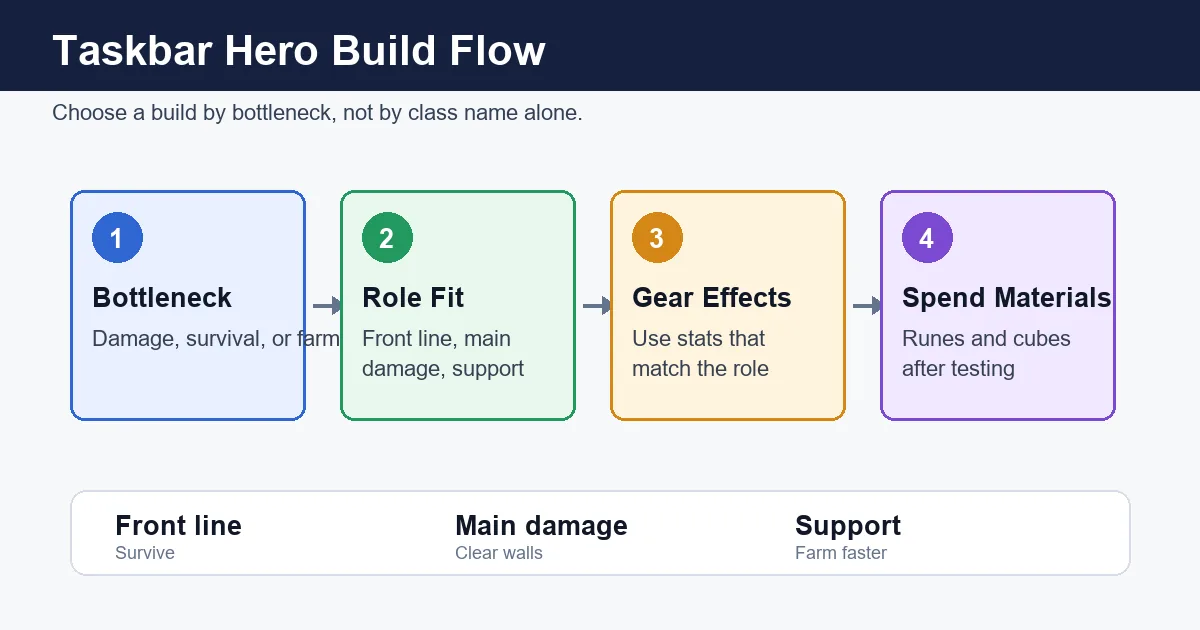
| Slot | Role | Priority |
|---|---|---|
| Front-line slot | Absorbs pressure and keeps long idle sessions from collapsing | HP, defense, recovery, mitigation, consistency |
| Main damage slot | Solves Act walls and boss-like fights when enemies survive too long | Attack, critical value, skill damage, clear speed |
| Support or farming slot | Improves materials, speed, utility, or a weakness the other slots cannot cover | Attack speed, drop value, utility skills, role patches |
When you unlock a class or find a rare item, identify which slot problem it solves before investing in it.
Three useful build types
The same class can play differently when gear effects and upgrade materials change. Use these three directions as a practical switchboard while learning where your account is stuck.
Act progression build
Use this when enemies are stopping progress. Push damage, critical value, and skill output into the main damage slot while keeping the front line just sturdy enough to survive the attempt. This direction is best for opening new Acts and difficulty context.
Stable idle build
Use this when long idle sessions produce too many deaths. Add durability, recovery, and safer gear effects without cutting damage so hard that fights become slow. For overnight or work-session farming, this can outperform a risky higher-zone setup.
Farming and material build
Use this when you can already clear a location and want more useful returns. Instead of forcing the highest possible zone, farm a reliable spot and improve speed, drops, inventory sorting, and market-candidate review.
Gear, rune, and cube priority
Upgrade materials should answer a real build problem. If you are unsure, use this order before spending.
- Name the current failure first: front line dying, enemies surviving too long, farming speed feeling slow, or inventory decisions becoming messy.
- Inspect gear effects before rarity. A rare item that does not support the chosen role should not receive your best materials yet.
- Use runes as a patch for the current weakness: damage for kill speed, HP or defense for survival, and speed or efficiency effects for farming.
- Use cubes only after a few short idle tests show that the item is likely to stay useful. Avoid heavy cube spending on pieces you may replace immediately.
- For Steam Market-eligible items, separate equipment value, storage value, and sale value before using or selling them. Live market information can change.
Free builds, DLC, and purchase decisions
The official Steam page presents the base game as free to play, but DLC, price, and feature details can change. Build planning should start with a free, reproducible foundation. Paid content or market decisions should only be considered when you understand which role they improve.
| Path | Best for | Caution |
|---|---|---|
| Free-first build | Learning Acts, class roles, gear filtering, and material saving | You may need better farming choices and stricter gear comparison when damage or survival is short |
| Selective DLC review | Players who expect to keep playing and want to shorten a specific role gap | Check the official Steam page for current content, price, reviews, and update notes before buying |
| Market-aware play | Players who want to judge tradable items before equipping or selling | Do not use a guide page as live trading advice. Item eligibility and prices can move. |
Build mistakes to avoid
Copying a best-build list without checking your bottleneck
A ranking-style answer can be useful, but your correct build depends on the Act, gear effects, materials, and the reason your current setup fails.
Stacking damage until idle sessions collapse
A fragile setup can look strong in a short push and still lose value over hours. Minimum survival and recovery are part of the build, not an optional extra.
Upgrading every new rare item immediately
Test new gear before investing. A high-rarity item with the wrong effects can consume runes and cubes that would solve a real wall later.
Taskbar Hero build FAQ
What is the best first build in Taskbar Hero?
Start with a stable damage build: enough damage to keep Act progress moving and enough survival that idle sessions do not fail repeatedly. Shift toward damage, stability, or farming based on the bottleneck.
How should I choose classes?
Choose classes by role. Decide whether the slot needs to tank, deal main damage, or support farming, then check whether skills and gear effects match that job.
When should I spend runes and cubes?
Spend them after short idle tests prove that an item solves a real problem or will stay useful. Avoid heavy spending on gear that may be replaced immediately.
Can I make a build without paid content?
Yes. Start with a free-first foundation, then review DLC or market decisions only after you know which role is missing. Always confirm current details on Steam.
What does this page answer for taskbar hero builds?
It explains how to choose roles, gear effects, runes, and cubes around a goal instead of only following a class ranking. Detailed rune use and market decisions are kept on their own guides.
What is the best Taskbar Hero build for early progression?
The best early build is a balanced team with one durable front-line role, one main damage role, and one support or farming role. Upgrade the slot that fixes the current failure: survival when runs collapse, damage when enemies stall progress, or farming value when clears are already stable.
What is a good beginner Taskbar Hero build example?
Start with one durable front-line role, one main damage role, and one support or farming role. Then tune gear and materials toward the current wall: survival, kill speed, or farming efficiency.